Shopify Teardown · lesdeux.com
Teardown: Les Deux - 6 SEO & AI-search gaps I'd fix first
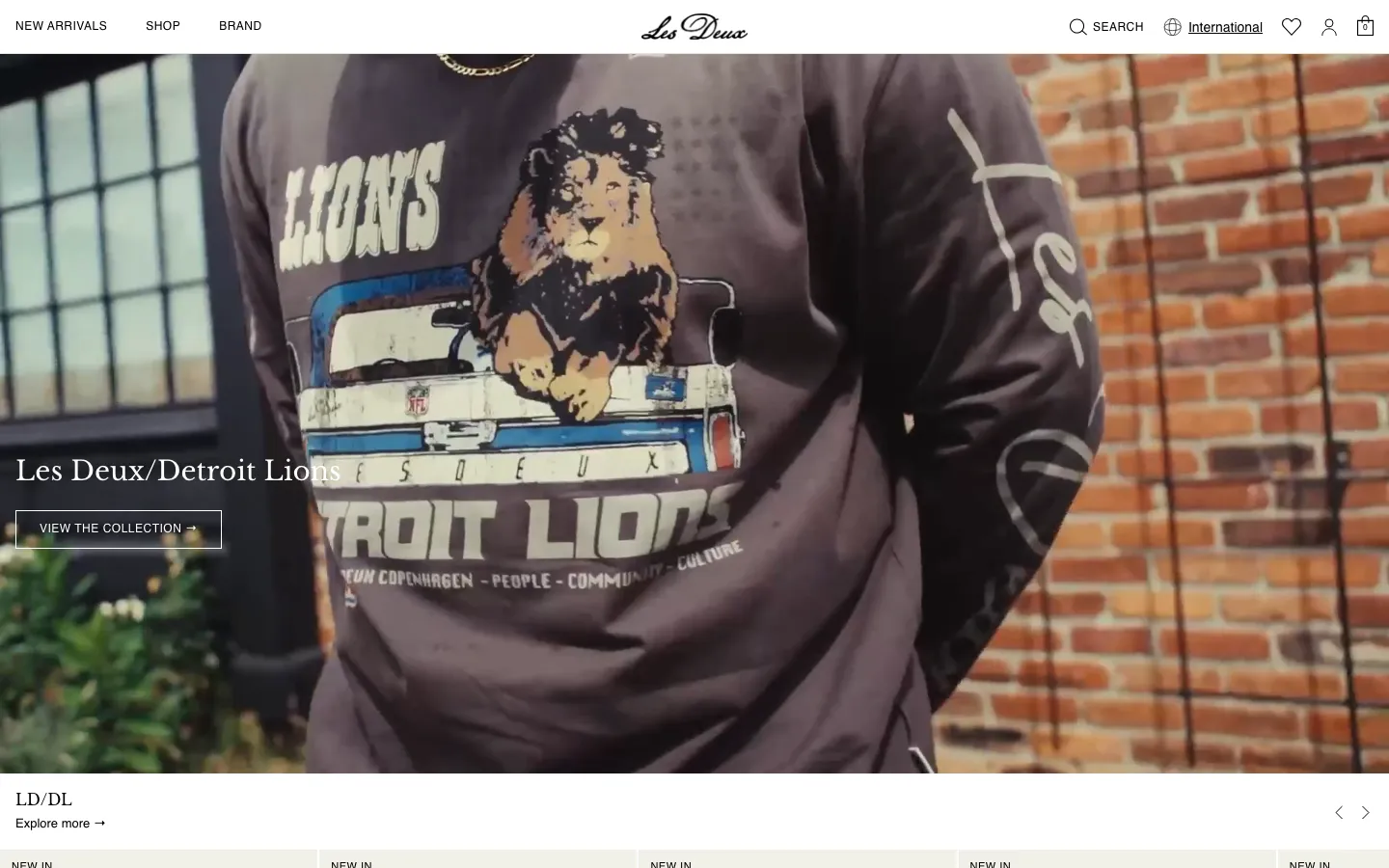
Les Deux runs one of the cleanest multi-country headless Shopify setups I've looked at: 11 country domains with reciprocal hreflang, real translations, and a GTIN on every variant in the product schema. So the gaps I found sit between Shopify, Sanity and the storefront code. Outside-in only, no access to their data.
86% of product pages share one title tag
What I found
69 of 80 random products from the .com sitemap carry the same <title>: "From danish fashion brand Les Deux | Les Deux", the tail of the brand's own pattern with the product name missing. Denmark and Germany match; .co.uk and .us are fine. Where titles exist, three markets still call the Core T-Shirt "Norregaard".
The evidence
/products/shell-jacket-black            From danish fashion brand Les Deux | Les Deux
/products/puffer-jacket-dark-navy       From danish fashion brand Les Deux | Les Deux
/products/tech-track-jacket-delicioso   From danish fashion brand Les Deux | Les Deux
/products/walid-suede-belt-brown        From danish fashion brand Les Deux | Les Deux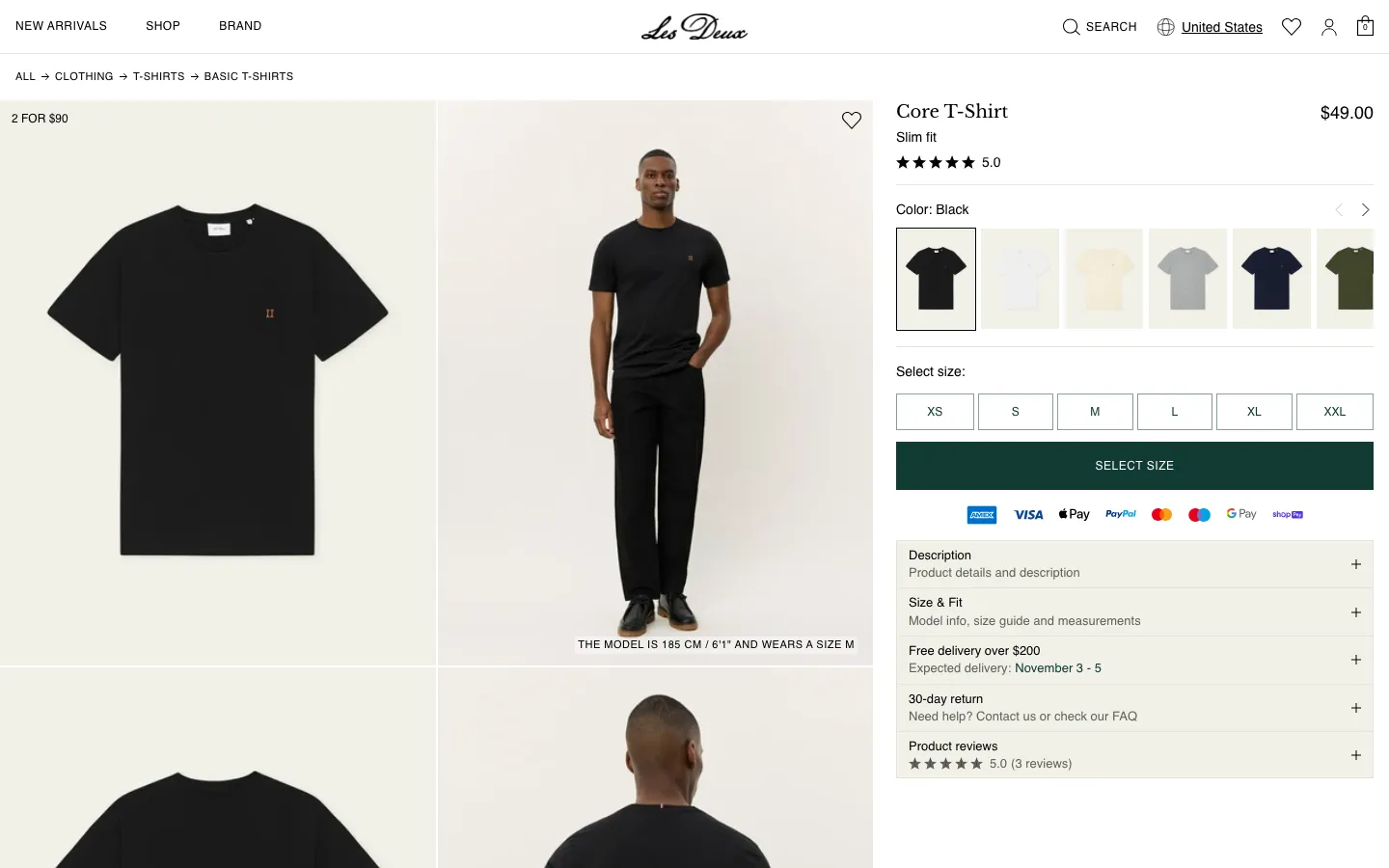
Why it costs money
The title is the strongest on-page signal for a search like "Les Deux shell jacket", and here it's identical on hundreds of pages. Google's own guidelines name boilerplate titles as a reason it rewrites them. 18 of the 80 meta descriptions are under 40 characters, like "Buy here".
The fix
- Fall back to the product name in the product route's
metawhen the SEO field is empty, e.g."Shell Jacket - Black | Les Deux". - Reuse the working .co.uk/.us pattern on .com, .dk and .de, and replace "Norregaard" in the remaining titles.
Every journal story is titled like the homepage
What I found
"Fits & Fades", "AW26" and the journal index all carry the homepage's <title> and meta description. None of the journal's URLs are among the 1,474 in the sitemap, and the articles have no Article schema.
The evidence
/                         Official Les Deux Brandsite & Online Store | Les Deux
/blogs/explore/c/all      Official Les Deux Brandsite & Online Store | Les Deux
/blogs/explore/fits-fades Official Les Deux Brandsite & Online Store | Les Deux
Why it costs money
To Google and AI answers, every story looks like another copy of the homepage. Editorial work like "Fits & Fades" is what earns links and citations.
The fix
- Map each Sanity article's SEO title and description into the journal route's
metaexport. - Add journal URLs to the sitemap route and output Article JSON-LD with author and date.
90% of the FAQ page is inline script
What I found
The FAQ page is 1.06 MB of HTML, and 90% of it is inline script. Most of it is site-wide settings the root loader sends with every route, and collection pages serialise their products twice (Shopify and Nosto).
The evidence
/pages/faq              1,056,505 bytes   89.8% inline script
/ (homepage)            1,338,483 bytes   89.1% inline script
/collections/clothing   1,964,878 bytes   76.8% inline script
Why it costs money
Real phone users feel it before the first pixel: CrUX shows a 1.7 s server response and 2.1 s first paint, both "needs improvement" (Google's "good" TTFB is 0.8 s or less). LCP sits at 2.4 s, 0.1 s under the limit.
The fix
- Slim the root loader to what the header renders. Move the rest to route loaders, or stream it with
defer. - Drop the duplicate Nosto payload from server state and cache global settings at the edge.
Four H1s on every product page, eleven on the homepage
What I found
Rendered, all 12 product pages I checked across .com, .us and .dk have four H1s: the product name, "Our recommendations", "Recently viewed" and "You might also like". Collections have three, the .com homepage eleven. One shared section-heading component outputs every module title as an <h1>.
The evidence
<h1>Puffer Jacket</h1>
<h1 class="max-w-[60rem] text-base">Our recommendations</h1>
<h1 class="max-w-[60rem] text-base">Recently viewed</h1>
<h1 class="max-w-[60rem] text-base">You might also like</h1>
Why it costs money
Google won't penalise a second H1, but the H1 is how search engines, AI crawlers and screen readers find the page's main subject. On 1,101 product URLs, "Recently viewed" now carries the same weight as the product it sits under.
The fix
- Give the section-heading component a heading-level prop that defaults to
h2. - Keep one H1 per template: the product name, the collection name, and one campaign headline on the homepage.
52 B2B and test URLs in the public sitemap
What I found
The .com sitemap lists 39 partner or B2B pages and 13 test URLs (7 pages, 6 collections). Test collections like draft-products-test return 200 with no noindex, so Google is free to index them. The .co.uk and .us sitemaps match.
The evidence
<loc>https://lesdeux.com/pages/partner-aw26-b2b</loc>
<loc>https://lesdeux.com/pages/klaviyo-popup-test</loc>
<loc>https://lesdeux.com/collections/draft-products-test</loc>
<loc>https://lesdeux.com/collections/test-discount-collection</loc>
Why it costs money
The sitemap is your shortlist for Google. Wholesale pages and experiments compete with real collections for crawl attention.
The fix
- Filter the sitemap route: skip noindexed pages, B2B pages and any
testhandle. - Unpublish the test collections and move partner pages behind the B2B login.
5.0 stars on the page, zero stars in the markup
What I found
Product pages show Lipscore ratings ("5.0 (3 reviews)" on the Core T-Shirt), but 0 of 6 I checked have aggregateRating: the widget renders in the browser. The homepages on 5 domains have no structured data at all.
The evidence
{"@type": "ProductGroup", "name": "Core T-Shirt - Black",
 "hasVariant": [{"@type": "Product", "gtin": "5711934007090",
   "offers": {"@type": "Offer", "price": "49.0", "priceCurrency": "USD"}}]}
// aggregateRating: missing
Why it costs money
The ProductGroup markup is excellent. Adding the rating is the last step to stars in search and stronger AI shopping answers.
The fix
- Fetch the Lipscore rating server-side in the product loader and add
aggregateRatingto the ProductGroup. - Output Organization (logo,
sameAs) and WebSite JSON-LD from the root route on every domain.
Quick wins vs. bigger bets
Quick wins · days, not months
- 86% of product pages share one title tag
- Every journal story is titled like the homepage
- Four H1s on every product page, eleven on the homepage
- 52 B2B and test URLs in the public sitemap
Bigger bets · biggest upside
- 90% of the FAQ page is inline script
- 5.0 stars on the page, zero stars in the markup
What I'd do in the first 30 days
- Week 1: Fix the product title fallback, give the journal real titles and add it to the sitemap. Clear test and B2B URLs out of the sitemap.
- Week 2-3: Switch section headings to H2, finish the Core rename in every market, render ratings server-side and add Organization schema.
- Week 4: Slim the root loader and the Nosto payload, then track TTFB and first paint in CrUX.
Les Deux already has the brand, the stories and a strong international foundation. These fixes let Google and AI answers see all of it, and that's organic revenue the brand doesn't have to buy with ads.