Shopify Teardown · avaofnorway.com
Teardown: AVA of Norway - 4 stores, 1 brand, 5 SEO gaps I'd fix first
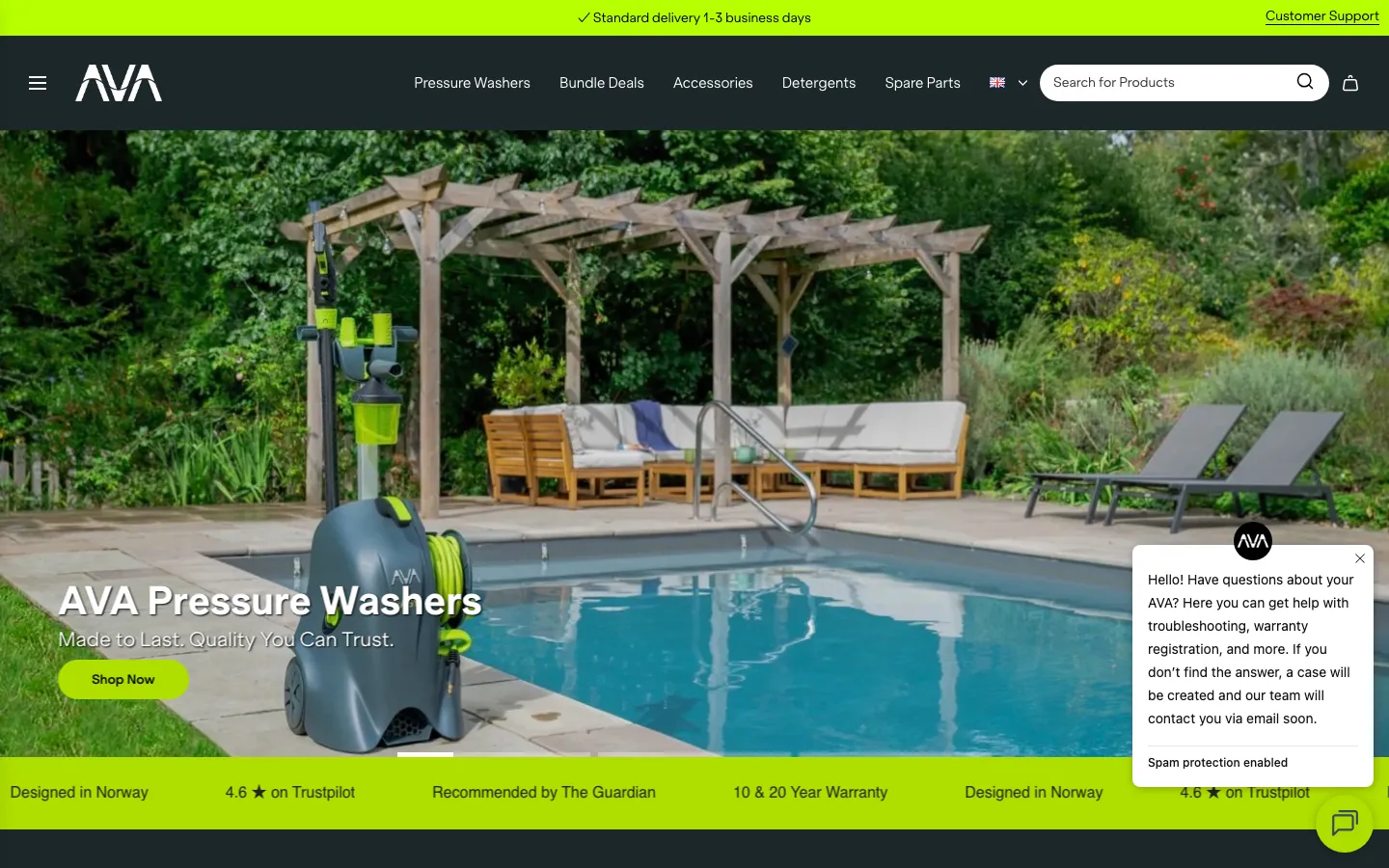
AVA does the hard part well: 4.6 stars on Trustpilot, a 20-year warranty on the Evolution P80, and a site real users find fast (CrUX phone LCP 1.7 s on the homepage). So I looked at how the UK store fits with its US, Norwegian and EU siblings. Outside-in only, no access to their data.
Four Shopify stores compete for the same English searches
What I found
avaofnorway.com (UK), .us, .no and .eu are four separate Shopify stores, each with its own copy of the theme. The same English product page exists up to four times. The foam cannon lives on .com, .eu/en-de, /en-nl and /en-be, each canonical to itself, and the three .eu copies are word-for-word identical.
The evidence
avaofnorway.com/products/ava-premium-foam-cannon-1l
avaofnorway.eu/en-de/products/ava-premium-foam-cannon-1l
avaofnorway.eu/en-nl/products/ava-premium-foam-cannon-1l   <!-- identical text -->
avaofnorway.eu/en-be/products/ava-premium-foam-cannon-1l   <!-- identical text -->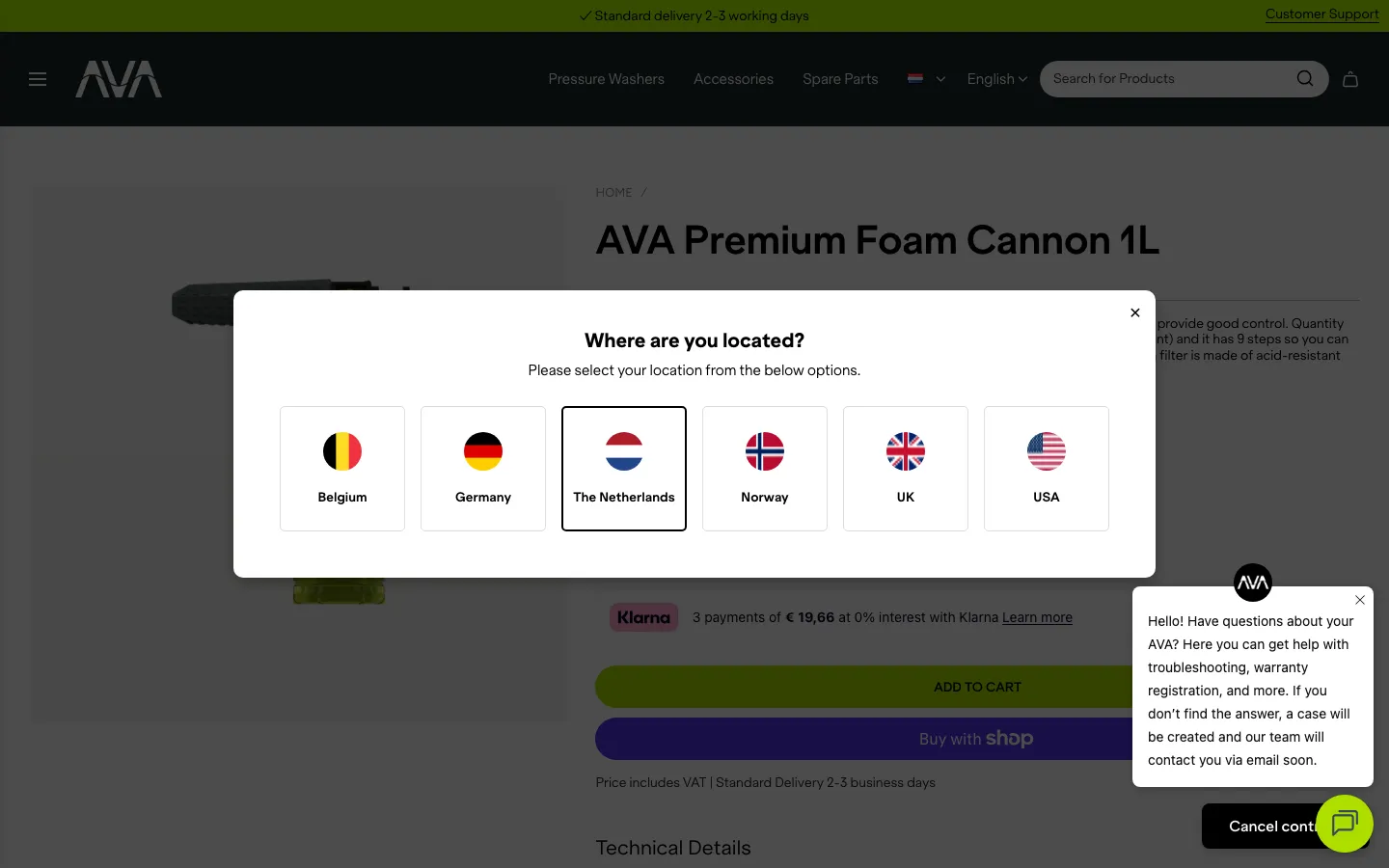
Why it costs money
Google picks one English version to rank, and it isn't always the right market's. Reviews, links and authority are split four ways. On .com, the geo-redirect script's US branch is empty, so US shoppers landing there are never sent to the US store.
The fix
- Now: one English URL per region on .eu, with the other English subfolders pointing their canonical and hreflang to it.
- Next: plan a move to one store with Shopify Markets (UK, US, NO, EU) for native hreflang, shared handles and one review base.
hreflang points 131 UK products at US pages that don't exist
What I found
The .com theme builds hreflang by pasting the same product handle onto every domain. But the stores use different handles: only 6 of 137 UK handles exist on the US store and 8 on the Norwegian one. The P80's US, Norwegian and two EU alternates all return 404. It also labels English pages (/en-de, /en-nl) as German and Dutch.
The evidence
<link rel="alternate" hreflang="en-us" href="https://avaofnorway.us/products/ava-evolution-p80-large">     <!-- 404 -->
<link rel="alternate" hreflang="no"    href="https://avaofnorway.no/products/ava-evolution-p80-large">     <!-- 404 -->
<link rel="alternate" hreflang="de"    href="https://avaofnorway.eu/en-de/products/ava-evolution-p80-large"> <!-- 404, and English -->
Why it costs money
None of the other three stores links back to .com, and Google's documentation is blunt: "If two pages don't both point to each other, the tags will be ignored." So the hreflang on .com is effectively ignored.
The fix
- Map counterparts in a product metafield (for example
custom.us_handle) and only output an alternate when one exists. - Match codes to content (
en-DE, notde) and add the same set, including .com, on every store.
4.6 stars on Trustpilot, zero stars in the markup
What I found
The homepage shows "4.6 ★ on Trustpilot", yet 0 of the 8 product pages I checked carry aggregateRating. The .com, .no and .eu homepages have no JSON-LD at all: no Organization, no WebSite. There's no BreadcrumbList anywhere, and the 20-year warranty on the P80 isn't in the markup.
The evidence
{"@type": "Product", "name": "AVA Evolution P80 Large",
 "brand": {"@type": "Brand", "name": "AVA"},
 "offers": [{"@type": "Offer", "price": 519.9, "priceCurrency": "GBP",
   "availability": "http://schema.org/InStock"}]}
// aggregateRating: missing · BreadcrumbList: missing · warranty: missing
Why it costs money
The trust signals that sell a £520 machine are invisible to Google's rich results and to AI shopping answers.
The fix
- Add product-level Trustpilot ratings to the Product JSON-LD. Company-wide ratings aren't eligible for product stars.
- Output Organization and WebSite on the homepage and BreadcrumbList on collections and products in
theme.liquid.
Collection grids link to 65 duplicate product URLs
What I found
On /collections/pressure-washer-accessories, 65 of its 73 product links point to /collections/…/products/… URLs. Their canonical is correct, but Googlebot still crawls them and internal links point at the non-canonical version. Utility collections such as "Cart Sidebar Product List" and a -copy collection titled "Master 2.0 P70" are indexable and in the sitemap, multiplying the effect.
The evidence
<a href="/collections/pressure-washer-accessories/products/ava-premium-foam-cannon-kit"
   data-product-id="9858299035975">
Why it costs money
Every grid I checked (4 of 4) sends its link signals to URLs that Google is told to ignore.
The fix
- In Flow's product card snippet, link with
product.urlinstead ofproduct.url | within: collection. - Set the
seo.hiddenmetafield on utility and copy collections to drop them from the sitemap and add noindex.
Every product page has two H1s
What I found
Each product page has two <h1> tags with the same title. The second sits in a hidden quick-view block that Flow embeds on every product template, with its own copy of the product gallery. It's on all 5 UK products I checked and on the EU store too.
The evidence
<h1 class="h2 product-details-product-title">AVA Evolution P80 Large</h1>
…
<!-- quick-view-product-template--…__product-form -->
<h1 class="h2 product-details-product-title">AVA Evolution P80 Large</h1>
Why it costs money
A small issue on its own, but it repeats on every product page in four stores and adds weight that shoppers never see.
The fix
- Render the quick-view title as
<h2>, or skip the quick-view section on product templates entirely.
Quick wins vs. bigger bets
Quick wins · days, not months
- Collection grids link to 65 duplicate product URLs
- Every product page has two H1s
Bigger bets · biggest upside
- Four Shopify stores compete for the same English searches
- hreflang points 131 UK products at US pages that don't exist
- 4.6 stars on Trustpilot, zero stars in the markup
What I'd do in the first 30 days
- Week 1: Fix the card links and the quick-view H1, and hide the utility collections. All are theme or admin changes.
- Week 2-3: Rebuild hreflang from mapped handles on all four stores, and add rating, Organization and breadcrumb markup.
- Week 4: Consolidate the English .eu copies and scope a single Shopify Markets store.
AVA already has the product, the warranty and the reviews. Today, four stores make Google choose between them. Connect them properly and each market's store ranks where it should, bringing in revenue AVA doesn't have to buy with ads.